
Evangelicals have a problem with authority
“The Myth of Good Christian Parenting” reveals how unhealthy teachings harmed children, parents, and the church family overall

Our first baby was just a few months old when I was introduced to Tedd Tripp’s “Shepherding A Child’s Heart.” Our church had chosen it for a book study, and as new parents we were eager to learn biblical parenting principles for the years ahead.
Tripp told parents we were called to be the authority in our children’s lives, and our “shepherding” should include identifying and exposing sin in our children’s hearts. God, he said, required parents to use “the rod” — to use spanking as a consequence for any failure of obedience, starting as soon as babies were able to “rebel” against a diaper change.
Several families at our small church followed Tripp’s guidelines — including some who trained their toddlers to sit through a sermon by taking them outside for “discipline” if they were disruptive. Even then I thought that went too far, but I otherwise knew these parents to be kind and soft-spoken. The wife shared her parenting philosophy with me, emphasizing that our goal should always be guidance and loving discipline, never “punishment” (retributive suffering).
I’d never heard a developed strategy for Christian parenting before, and the idea that I could discern sin in my children’s hearts didn’t strike me as unhealthy or intrusive. From my inexperienced perspective, her advice and Tripp’s book were wise, practical, and biblical.
I no longer see it that way. In fact, we’ve apologized to our kids many times for what we now see as parenting failures. We regret how we practiced discipline in our children’s early years, and how we overemphasized “obedience” as the goal of our relationship. What Tripp offered turned out to be an illusion. The methods he and many other Christian parenting experts taught may have encouraged compliant behavior, but it did not promote healthy, trusting relationships.
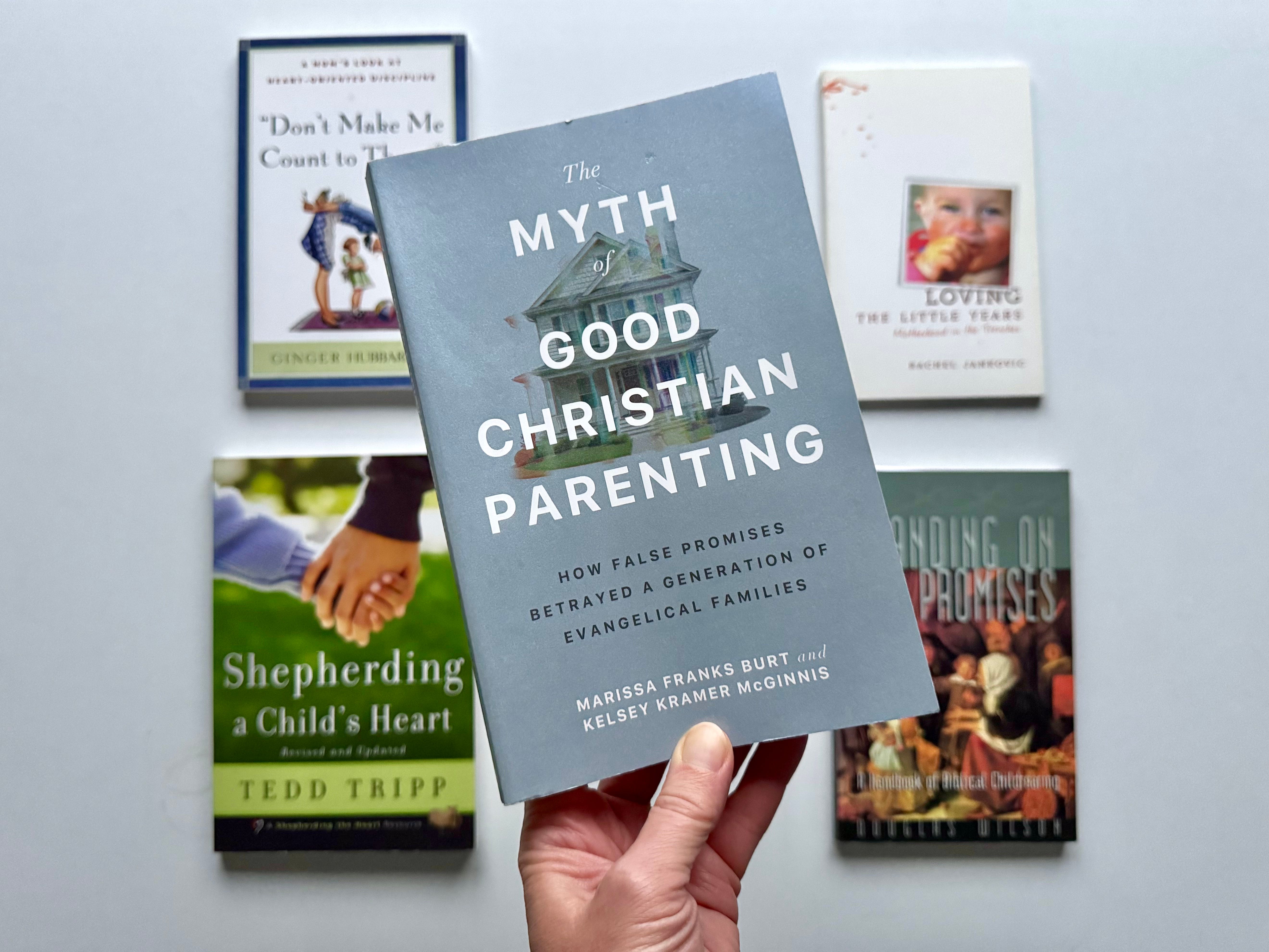
Our experience made me eager to read “The Myth of Good Christian Parenting,” by Marissa Franks Burt and Kelsey Kramer McGinnis. The subtitle of their book is “How False Promises Betrayed a Generation of Evangelical Families,” and I certainly count our family among those betrayed.
It all comes back to ‘authority’
I don’t typically write about parenting, but was surprised to see how this book overlaps with topics I care about: women’s roles in the church and family, as well as church culture and spiritual abuse. As it turns out, the advice that created so many problems within Christian families rested on the same foundations as teachings about other Christian relationships, especially marriage and church membership. The way authority was taught and practiced within evangelical circles has caused immense harm in the broader evangelical church family over the past 40+ years.
But before we go there, let’s do a quick overview of the book.
Since the title includes the words “myth” and “false promises,” readers might expect the book to directly attack these misleading claims. Instead, Burt and McGinnis take a more indirect, and ultimately effective, approach. They trace the history of the Christian parenting movement, connect it to broader trends in U.S. and church history, and examine the underlying assumptions of its teachings. The false promises of Christian parenting were rooted in specific beliefs about authority, gender, and politics. They relied on ideological and doctrinal commitments such as biblical inerrancy and distrust of “secular” science and psychology.
Burt and McGinnis show how the Christian parenting experts of the last 50 years rarely had relevant education in psychology or child development. Their expertise was limited to their own personal observations, bolstered by Bible verses applied out of context. They believed that raising children “should” work this way, and were confident enough in their opinions to sell materials to parents desperate for help. This was a recipe for their success, but not for the families who relied on them.
As I prepared to write this, I picked up my 15-year-old copy of “Shepherding A Child’s Heart.” This quote from the introduction is a perfect example of the myths behind the Christian parenting movement.
“Today’s parents are part of the generation that threw off authority. The racial and antiwar protests of the 1960s powerfully shaped their ideas. The protest movement took on the establishment. It changed the way we think about authority and the rights of the individual. As a result, it is no longer culturally acceptable for Dad to be the “boss” at home. Mom doesn’t obediently do what Dad says, or at least pretend she does. Dad for his part, no longer lives in fear of the boss or of being fired through caprice. Yesterday’s bosses used authority to accomplish their goals. Today’s bosses use bonuses and incentives.
“What is my point? Simply this: Children raised in this climate no longer sit in neat rows in school. They no longer ask permission to speak. They no longer fear the consequences of talking back to their parents. They do not accept a submissive role in life.”
I was saddened to realize my 26-year-old self had simply accepted this argument; its problems are blindingly obvious now. Tripp’s underlying assumptions about power and leadership are concerning:
Men (or at least fathers) should hold unquestioned authority within the family, and there ought to be a hierarchy of power, with men over women and children.
Using fear to achieve compliance is an acceptable way to wield power in the home and in the workplace.
Those who question authority are presented as rule breakers and disturbers of the peace. Meanwhile, “sitting in neat rows,” i.e. exhibiting outward conformity and compliance towards authority figures, is presented as ideal behavior.
Also evident in this quote is a connection between family life and political concerns — the “protest movement,” Tripp suggests, has encouraged children and other inferior groups to rebel against their “submissive role in life.” As Burt and McGinnis point out, Tripp wasn’t the only one who saw it this way: “It is impossible to separate popular Christian parenting books of the late 20th century from the aims of the Christian Right. Family values were a key tenet of that agenda — as was law and order” (75)
For Tripp, Dobson, and many others, parenting was political: part of an effort to preserve a specific social order. This was one of the most surprising and helpful insights of “The Myth of Good Christian Parenting.”
Burt and McGinnis provide a comprehensive survey of the common themes in Christian parenting advice, bringing to light the authoritarian impulses underneath “biblical” arguments. When a leader believes they are entitled to “submission” and is empowered to use fear or even pain to extract obedience from those under their care, this is a recipe for abuse. Many children experienced just that.
“American evangelical family-life teaching cultivated narcissistic parenting,” McGinnis and Burt write. “The framework they had been offered told them that parents who love their children control them… and children had been taught that loving their parents equaled complying without question. This combination is unsustainable for adult human relationships.” (168-169)
Unsustainable for adult human relationships.
This is true. And what struck me is how many relationships within the evangelical church have been patterned on the same model of absolute control by authority + unquestioning compliance of those under its power.
Will you choose ‘obedience’ or not?
In the word choice and phrasing of Tripp’s paragraph above, I heard familiar echoes: words like “roles,” the presentation of an idealized past in which everyone knew their place, the danger of a “culture” opposed to Christian ideals. In my decades within evangelical churches, these same concepts were used to teach me about gender roles, about submission to church leaders, and the importance of compliance with a certain set of doctrines (and the danger of questioning these).
Burt and McGinnis point out how the boom of Christian parenting advice in the 1970s can be seen as a reaction to the cultural and political turmoil of the previous two decades. Dobson published “Dare to Discipline” in 1970, and “The Strong-Willed Child” in 1978.
These parenting trends overlapped with efforts to shore up other traditional forms of authority within the church. In 1978, a group of evangelical pastors and theologians created The Chicago Statement on Inerrancy. Framed as a defense of the Bible against liberal/modernist “attacks” on Scripture, it claimed the interpretive preferences of the signers — practically all of whom were white men1 — to be absolute, divinely inspired truth.
And in 1988, the Danvers Statement on Biblical Manhood and Womanhood sought to preserve traditional gender hierarchies in marriage and the church. The group who signed that statement helped to create CBMW, which today continues to advocate for “male headship.”2

These messages filtered down through parachurch organizations, Christian publishing and conferences, and to local churches. I heard them clearly in each church I attended. I was encouraged to trust and submit to the authorities God had placed “over” me: to my husband, to our pastor, to church leaders (men, again), to the men in my corner of the global church who decided what the Bible said.
And in each of these areas, my personal agency was reduced to what Burt and McGinnis helpfully frame as the “binary choice between obedience and disobedience” (92). This was the only decision given to children, and it was the only decision presented to those without power in evangelical systems:
Women could choose between “following God’s beautiful design for womanhood” by submitting to male authorities, or we could choose to “usurp” men’s power.
Wives could respect and submit to their husband’s “imperfect” leadership, or choose to rebel and undermine it.
Evangelical Bible readers could accept the doctrine of inerrancy — which really meant agree with the interpretations of white men who invented the term — or they could choose to “attack” the faithfulness of Scripture.3
Evangelical teachings flattened the relationship between leaders and those under their authority to a false binary — obedience vs. disobedience, submission vs. rebellion. These patterns will inevitably lead to abuses of power and destroy relationships.
This is what a generation of evangelical families discovered, as Burt and McGinnis point out — both in their subtitle and in numerous statistics and personal anecdotes throughout the book.
“If families followed the teachings in many of these resources… people were abused in the name of God.” (176)
Family dynamics mirror the broader church
Sadly, the same authoritarian dynamics were taught to evangelicals in their other relationships, and the outcome has been the same: abuses of power and broken relationships.
Women suffered in abusive marriages, then were coerced to stay in harmful relationships by the pastors they turned to for help. Pastors manipulated and took advantage of church members, whether financially, sexually, or for social media clout. Children raised in the church were driven out for asking the wrong questions. (And of course, evangelicals have aligned themselves with authoritarian politicians, as Kristin Kobes DuMez has pointed out.)
In each of these spheres, God or “the Bible” has been misused to prop up authorities who didn’t deserve the power they’ve been handed. This is typical of weak or incompetent leaders, who manage through threats and manipulation rather than doing the hard work of building trust.
In the past, the fathers, husbands, and men of the evangelical church were encouraged to believe they deserved obedience simply because of gender or longstanding tradition. But over the last 50 years, those assumptions have been challenged. New justifications for male authority in the church and in marriage (aka complementarianism), the push for inerrancy, and the trend of top-down church leadership structures are all the result of insecure leaders grasping after spiritual justifications for power.
When parents were encouraged to emphasize their “authority” while minimizing their children’s opportunities to think, speak, and act independently, it’s no wonder many of those children no longer feel safe in their families of origin. And since members of church families have suffered similar tactics, the so-called “trend” of deconstruction looks more like a healthy response of self-protection.
Burt and McGinnis name it accurately: “When timebound cultural perspectives are presented as timeless truths, people who come to recognize and reject the former may have difficulty retaining any of the latter. Indeed, the entire contemporary movement of deconstruction is a direct response to ways evangelical teaching shaped a generation.” (68)
Although this post has been less of a traditional review than reflection and response, I’ll close with a few notes of appreciation for The Myth of Good Christian Parenting.
Let’s not create a new generation of ‘authorities’
I grew up hearing my parents listening to “Dr. Dobson” on the radio. For most of my life, I was completely unaware of the fundamentalist and authoritarian framework of the evangelical culture around me. I’ve worked to reevaluate and — yes — “deconstruct” the unhealthy portions of my faith, but “The Myth of Good Christian Parenting” helped me connect the dots in new and helpful ways.
This book put in perspective my struggles with “gender roles” and biblical womanhood, biblical inerrancy and pastoral authority. I can see how these teachings were likely motivated by anxiety over the loss of traditional authority structures, rather than “faithfulness to the Bible,” as I always heard.
I especially appreciate how Burt and McGinnis refuse to take the route of condemnation or accusation. They don’t claim to know the motives of those who perpetuated harmful doctrines. Rather than ascribe intent, they point out blind spots. We as readers are shown the harmful impact of these concepts, but we’re not encouraged to see the teachers themselves as villains. That sort of fundamentalism was a feature of the teachings that harmed us, and we’d do best to leave it behind.
It’s also noteworthy that they don’t attempt to prescribe parenting advice themselves. (other than spanking is a really really bad idea). It would’ve been easy — and marketable! — to present a new “solution” to Christian parenting problems. Instead, Burt and McGinnis encourage readers to hone their own discernment. The back of the book even includes a helpful rubric that parents can use to evaluate resources for themselves.
Many of us have walked away from harmful evangelical systems only to find a new set of “authorities” ready and waiting, hoping we’ll hand over our discernment… and our cash. We don’t need to replicate the same old system, just with different authority figures. We DO need experts who are willing to educate and empower others to make their own decisions.
Dr. Spock was known for telling parents, “Trust yourself, you know more than you think you do.” We might rephrase in a less catchy way: “Trust the Holy Spirit in you and in your community, while also learning from experts… you’ll know more than you think you do.”
If you’re as interested as I am in the topics of leadership and authority, I’m currently reading Christa McKirland’s intriguing new book “A Theology of Authority: Rethinking Leadership in the Church.” A few other Substack friends are reading along. I look forward to discussing and sharing more in a future post!
Rick Pidcock explained: “The Chicago Statement on Biblical Inerrancy originally was signed by 334 people. After looking up every name on the list and asking some of my seminary professors to review the list, I was able to confirm four Hispanic men, one Black man, one Asian man, and five white women who signed the document. But those 11 people are merely drops in a sea of white males.”
Per their vision and mission page: “In 1987, CBMW was established primarily to help the church defend against the accommodation of secular feminism…” The organization continues to deny that belief in a divinely ordained gender hierarchy contributes to abuse.
For more on this, see Pete Enns,“Inerrancy Doesn’t Describe What the Bible Does.” Zach Lambert’s recent book “Better Ways to Read the Bible” also has a helpful section on inerrancy.
My husband forwarded me your post and as I was reading it I thought, “I would love to send her a copy of my book to see what she thinks. This resonates so much with me,” and then I got to your post script (which he hadn’t gotten to yet)! Thank you for your important work and I look forward to hearing what you think about my book.
Excellent comments on what was and this new book. I also read Shepherding as a young parent (almost 30 years ago) and thought it was great except I didn’t agree with spanking. Then I went to give it as a gift, but decided I should read it again because so many of my views had changed and thought it was rubbish advice. I did not give the gift of that book.